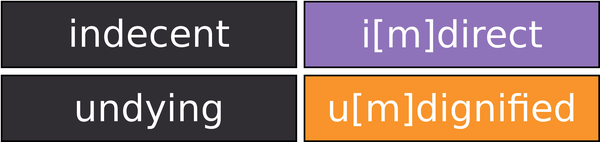
Some of our early work addressed the sound structure of stored word forms, focusing specifically on the role of alternating sounds in the perception of two English prefixes: <in-> and <un->. These two prefixes provide a convenient pairing because the pronuncation of <in-> alternates depending on the stem it is attached to (for instance, i[n]decent, i[m]balanced), whereas the pronuncation of <un-> is more stable (compare u[n]detered, u[n]becoming).
These kinds of sound alternations have been used to argue for theories of word storage which are underspecified. In other words, we might not store as much detail about the pronuncation of `in-’ in our memory, because we expect it to change pronuncation in predictable ways.
We tested these predictions in a series of behavioral and electrophysiological (ERP) experiments to see whether subjects could detect mispronounced versions of these prefixes (e.g., u[m]becoming or i[n]balanced). All three experiments showed the same pattern of responses which suggest a complicated interplay between two separate systems: one, consistent with an underspecified lexicon where people do have less specific expectations for <in->, and another utilizing knowledge about how sounds vary in English more generally, making people much more likely to accept `u[m]becoming’ as a well-prounounced word compared to something like u[m]tolerable.