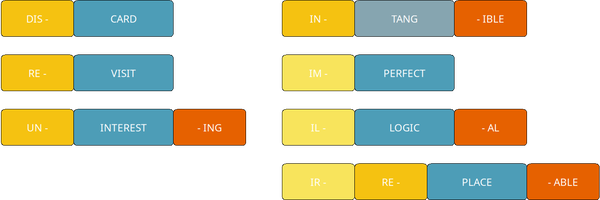
A long-standing question of interest in our lab is in how complex words and stored and processed by the brain while listening to speech. Complex words are words like disenchated, which are made of a root (enchant), plus some number of prefixes or suffixes (dis- and -ed). In reading studies, research has suggested that people break these words apart in a process called morphological decomposition, as well as accessing a full copy of the word in their memory. In this project, we’re exploring whether the same processes apply in speech perception, where listeners would not have information about upcoming parts of the words (such as what root follows a particular prefix, or how many suffixes the word might have).
In a recent collaboration with Ehsan Solaimani (L+PLUS alumnus, now at the University of York), we’re looking at brain signatures of complex word processing using single-trial EEG. Using GAM models to estimate changes in brain response over time as a complex word unfolds, our preliminary work suggests that in speech perception people do decompose words, but not to the same degree we see in written language processing.
We’ll be presenting some of this work at this year’s Society for the Neurobiology of Language conference, at Gallaudet University. Find us there!